 |
 |
 |
 |
|
|
|
|
|
  |
|
Akita InformationAll Time top Akita breeder says “best description ever” of the breed’s most important feature.The Akita Headby Francee Hamblet courtesy: The Working /Herding Dog Digest
Whether you are a Judge or breeder, study this document and head photos for correct Akita heads.
…from the introduction of the Official AKC Standard for the Akita: “The broad head, forming a blunt triangle, with deep muzzle, small eyes and erect ears carried forward in a line with the back of the neck, is characteristic of the breed.”
The initial description in the standard describes a head that is massive…not large, not big, not good sized but massive. It goes on to state “in balance with the body” but the body itself is described as large with much substance and heavy bone. So the very first impression one should have of an Akita’s head is one of extreme size. This should be seen on both dogs and bitches as there is nothing in the standard that differentiates between them in this category. There are several standards of other breeds that specifically call for bitches to be feminine in appearance but the Akita standard is not one of them..
The description continues with “skull flat between the ears and broad”. The standard also calls for a shallow furrow. Flat and furrowed are somewhat contradictory so I interpret “flat” to mean “flattish”, not domed or crowned, but with enough softening of muscling to allow a furrow and so the top skull won’t appear as flat as say a Doberman or Schnauzer. The top of the skull must allow for sufficient cheek muscle attachment to give the very distinct blunt triangle appearance and to help form the well defined stop. Without that broadness, the head would never appear as massive. In fact, a narrow or snippy head is a fault per the standard. As well as the head being broad, the jaws should be square and powerful and the head should form a blunt triangle when viewed from above. So the three sides of the head, when viewed from the top should be equal in length and come to a squared off muzzle at the end of two sides, thus creating the “blunt” end of the triangle. Again, this supports the very broad head and continues to give the overall massive appearance.
The muzzle is described as broad and full. One of the few actual measurements in the entire standard is from nose to stop and from stop to occiput (the very back of the skull) and the ratio should be 2 to 3. The occiput or end of the skull is easily felt and the back of the ear joins the skull just about in a line with this point. A good general example of this ratio would be a muzzle that measures 4 inches from nose to stop and then 6 inches from stop to the back of the skull, making the entire length of the head 10 inches. This is a very easy measurement to visualize. If the back skull and the muzzle are the same length or nearly so, this is an equal ratio as called for on a Collie head and very incorrect for an Akita. If the muzzle is actually longer than the back skull, so that the back skull measurement was 4 inches and the muzzle length was 5 inches, this would strongly contribute to a narrow or snippy sort of head and should be considered a fault.
As for the muzzle itself, the standard calls for it to be deep as well as broad and full. If the muzzle is short in relation to back skull, it should fit very broadly into the face and gradually taper to form that distinct blunt triangle. In order to have a muzzle that is deep as well as broad there must be a square-ish upper jaw as well as a strong, well-boned lower jaw. Both jaws should meet evenly and form a perpendicular line when viewed in profile. When viewed from above, this will create the end to the “blunt triangle”. The broad muzzle will also give the foreface a wide appearance as well as contributing to a well-sprung zygomatic arch (cheekbone), resulting in good “fill” below the eye thus adding to that wide, massive overall blunt triangle appearance of the overall headpiece. The cheeks, which are basically formed by the muscles attached to the skull and jaw at the TMJ joint, also give the head its triangle shape. Flat cheeks and narrow, weak jaws will have poor jaw muscle development in both appearance and feel and leave the head looking narrow and snippy. The bones of an Akita skull, including the jaws, must be strong and large enough to provide sufficient support for the necessary amount of muscling to give the headpiece its massive appearance. Slight bones often have less muscling and again, will therefore reflect that narrow, snippy appearance.
The Akita head must have a stop. The stop should be “well defined but not too abrupt”. The stop on any dog is actually created by the slope between the frontal bones and nasal bones of the skull. Those bones lie on different but parallel planes. The steeper the angle of the slope between the two sets of bones, the deeper the stop. The addition of muscling over the top skull will add to the depth of that stop. If the stop on an Akita is not well defined, the underlying bone structure is incorrect. This will cause the stop to appear as a shallow slant rather than a distinct change of planes and the impression of massiveness suffers. If the stop is too extreme, again the bone structure is incorrect and the head will appear too domed and the shallow furrow will be lost.
Another very important feature, and mentioned twice in the standard, are the eyes. The eyes should be small and deep-set and they should give the appearance of a triangle. They should be dark brown and if they are properly deep-set and have the correct size, they will appear nearly black. The eye rims should be black and very tight. Light eyes are incorrect and ruin the expression that should reflect the alert and responsive description of an Akita temperament.
Even though an Akita head should be massive, the features should all still be very tight without looseness, sloppiness or wrinkle. Lips, eye rims, ears, even the skin itself on the head should all be tight and firm with as little sagging or drooping as possible. Young dogs tend to have more looseness that allows for room to grow but any appearance of sloppiness on an adult should be considered incorrect.
The head is so important that nearly half of the disqualifications and faults in the breed standard involve something about the head. Partial or total lack of pigmentation on the nose leather, dropped or broken ears, over or undershot bite, snippy or narrow muzzle all make a dog disallowed or unacceptable for conformation shows and should be equally unacceptable in a breeding program.
One of the Akita’s most talented and famous breeders once described an Akita head as a symphony of triangles…a description that is as apt today as it was thirty years ago. When the head is made correctly, with near perfect features, it is indeed a symphony of not only triangles but also a magnificent combination of power and beauty that completely captures the essence of the breed. EST 1998 Copyright ? TheDogPlace.org 2001-2021 1421609 https://www.thedogplace.org/Breeds/Akita/Akita-Head_Hamblet-142.asp SSI
SSI Advertising ~ Disclaimer ~ Mission ~ Privacy
ii NetPlacesNetwork ~ ii Health Disclaimer
Brought to you by the NetPlaces Network
TheDogPlace.org, world’s 1st public website, 1st online dog news, TheDogPress.com, and TheJudgesPlace.com, 1st AKC dog judges site
|


 The description of the Akita head is the second sentence of the standard. The description of the head itself is the first point of conformation addressed in the standard as well as the most detailed making the headpiece, at least in words, one of the most important aspects of the breed. Indeed, that introductory sentence says that it is what distinguishes the Akita from all other breeds. So it’s fairly safe to say that when one sees an Akita head there should be no doubt about what breed that head belongs to….the head should “say” Akita.
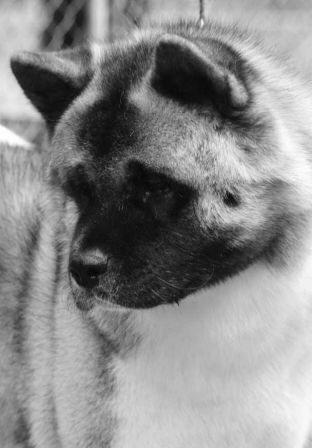 Probably one of the most unique and trademark features of the Akita are the ears. If they are correct, they are unlike the ears of any other breed. The standard calls for ears that are strongly erect (not soft or floppy) and small in relation to the rest of the head (massive head and small ears). If the ear is folded forward, the tip will touch the upper eye rim. The absolute key to this sentence is that the ear be exactly where it belongs on the head in the first place. If the ear is placed incorrectly on the head it will need to be the wrong shape or much too large in order to reach the upper eye rim. The ear itself should be triangular and slightly rounded at the tip (mimicking the whole head shape) and wide at the base. They should be set wide on the head but not too low. If they are too low-set on the head the ears will tilt outward too far like a Cardigan Welsh Corgi. A dog with very high-set ears that are upright and close together is not only very incorrect, it’s often indicative of a narrow skull and the entire shape and character of the head is lost. Unquestionably the most important statement about ear placement is that they are carried slightly forward over the eyes in line with the back of the neck. To get the correct visual image, one must remember that the neck is described as having a pronounced crest that blends with the back of the skull. So this curved line that contributes to the crest should continue in an unbroken visual arc to the tip of the ears when looking at the head in profile. This arc should be viewed whether the muzzle is parallel to the ground or pointing downward. If the ears are too upright and the neck is also upright without obvious crest, then both are incorrect. If the only way to accomplish a crest and the proper appearing ear-set is by tilting the muzzle downward, then both are incorrect. The proper ear set can easily be seen when the head and muzzle are upright. This ear placement is what sets the Akita apart from all other breeds and it should be noted that this breed characteristic is mentioned in the introduction as well as the body of the standard.


