|
|
|
|
|
|
Chinese Shar-Pei Information
Chinese Shar-Pei History lesson, study this document and photos!HISTORY of SHAR PEI in CHINAby Judge Eric T. Omura - 2000
Before I go into the topic of Shar Pei, I want to show you first the fabulous show ground in China which is available specifically for dog shows. The place is in Zuhai, which is not too far from Hong Kong. About one and a half hours by boat.
Now, more on the Shar Pei breed.
Based on my research over here in Hong Kong, it has come to my knowledge that the breed was first introduced into the U.S. in the 70's. There might have been some imports into the U.S. in the late 60's but the 70's was the period when the breed really became well known in the Western world.
It first started off as a breed from China, a traditional dog with a distinctive "sandy skin" feature, coarse to touch, and a very agile functional dog which had been used for ages in olden days for working such as hunting, watch dog, and fighting. Shar Pei is not used for fighting anymore and this sport itself is illegal in Hong Kong and China today. Definitely the breed is a primitive and a working type by history.
Somehow, things went wrong along the way of development and breeding when the breed was more and more depicted in the West for it's rareness, it's exaggerated folding skin and thus it's funny look, and as a "pet" dog. Together with the skin folding came also the heavy mouth padding, and bushy tail all in their exaggerated form. Very soon, people realized that this trend headed into disaster for the breed. Skin problems, entropia, reverse scissor bite, over padding causing problems in eating etc. My observation is that this strayed course of development is due largely to market driven breeding without a clear counter balance of view and understanding in the market of what constitutes this breed and what it should look like. This is not surprising because of the Shar Pei's short and brief history to be known in the West. Not many people can define what a Shar Pei should look like. So here comes the wrinkles becoming synonymous to the breed.
Take Dachshund for example, every citizen in this world has a pretty good idea of how a dachshund should look like. So any breeder who bred, say, a "giraffe-like" dachshund would not sell. Not so much that people would not buy it as a "dog", but people would not buy it as a "dachshund".
Because of the large profitable U.S. market, even Chinese breeders here bend to breed the "wrinkles". But honest people here can tell original Shar Pei is not just wrinkles; it should be a sound, healthy, agile working dog! So we are now faced with 2 distinct types of dog, one for the American pet market type and one original traditional type. It is clear that no way we can put the two types into the same ring to show as one type. Therefore, consensus soon developed here to show the dog separately in dog shows.
In China, it is now common to show Shar Pei under 3 varieties. They are:
At this stage in history, it is the only way to sort out the differences when huge contemporary market interest clashes with tradition. Respecting the living reality while saving the past. But many problems remain to be addressed in future course of development which is not simply a Shar Pei problem alone. I am attaching here with this e-mail a paper written by me on this subject which I had presented to the Midland Shar Pei Club in England a few months ago for a seminar there. I might have opened a can of worms but it's only about biological sense.
In short, we must breed dogs only on biological soundness and should never breed in accordance to market needs.
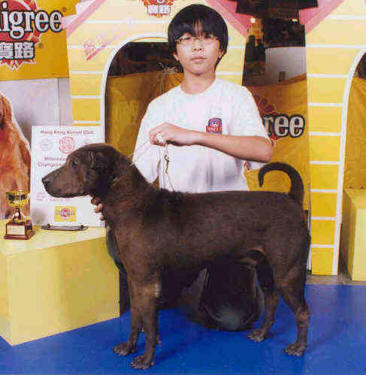
The following photos are of traditional type Shar Pei now kept in Lana Tsan's kennel.
Besides the head, skin and coat, another very important feature of Shar Pei, which I believe should be common to both pet and traditional type, should be the tail and its setting. "High and well over the croup" is the definition. Tail should be with strength, pointing up and forward and should not drop, or droop at all time. Tapering towards the end and definitely not brushy or bushy.
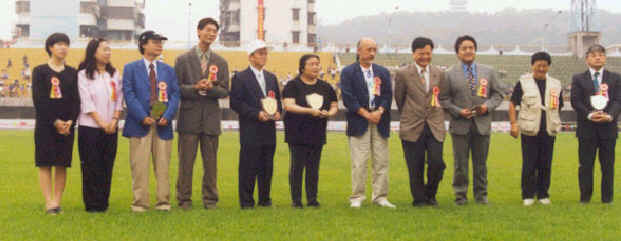
Before I say good bye, please allow me to introduce us in the following photo:
Copyright ? 1998 TheDogPlace.org 2001-2021 2000 https://www.thedogplace.org/Breeds/Shar-Pei/History_Omura-00.asp SSI
SSI Advertising ~ Disclaimer ~ Mission ~ Privacy
ii NetPlacesNetwork ~ ii Health Disclaimer
Brought to you by the NetPlaces Network
TheDogPlace.org, world’s 1st public website, 1st online dog news, TheDogPress.com, and TheJudgesPlace.com, 1st AKC dog judges site
|