 |
 |
 |
 |
|
|
|
|
  |
|
MINIATURE BULL TERRIER
In-depth Mini-Bull background, first English Imports, forming the MBTCA in 1984, attaining AKC recognition, approval-acceptance of the Miniature Bull Terrier Breed Standard in 1991.Miniature Bull Terrier Historyby Founding President, Barbara "BJ" Andrews
The Miniature Bull Terrier originated in England circa 1850. The MBTC England formed in 1938. First Miniature Bull Terrier Champion was made up in 1948. The long defunct American Miniature Bull Terrier Club was revised in 1984 by Pam Glave and Barbara Andrews who attained AKC recognition for the Miniature Bull Terrier Club Of America, the MBTCA.
Credited breed originator James Hinks experimented with bulldog and terrier crosses, including the now-extinct English White Terrier. Prior to the type created by Hinks, even the fighting type bull and terrier was small. Sporting Dog Magazine wrote in 1804 of a top ranked fighting dog called Trusty who weighed in at 42 pounds.
Miniature Bull Terrier SizeQuoting from A Miniature Bull Terrier History by Charles Allenden, published by the Miniature Bull Terrier Club Of England “Most of the old ratting prints of this time feature a small dog of the bull terrier type, which are reported to have weighed between 9 and 12 lbs. Some breeders tried to miniaturise the breed further to produce a Toy Bull Terrier. Pony Queen, owned by Sir Raymond Tyriott Wilson, has been recorded as under 3 1bs in weight when fully grown. However, these Toy types were generally not typical of the breed, having apple heads and pop-eyes, characteristics typically associated with the dwarfing of a breed.”
In one of many trips to the U.K. Mrs. William L. Andrews ("BJ") visited the Kennel Club Of England and was given access to original stud books and other historical MBT treasures. In The Miniature Bull Terrier (TFH Publications) by Barbara "BJ" Andrews we learn “The night of Neat’s benefit” in November 1821 advertised a famous eighteen pound fighting bitch and there are many other references to fighting dogs of six to twenty pounds about during 1820 and 1850. Records from the Kennel Club (England) Stud Book, First Volume indicates that small Bull Terriers were quite numerous and in fact, the first recorded Bull Terrier Champion weighed less than sixteen pounds! He was whelped in 1866, recorded in the stud book as #2758 Nelson.”
Mr. Shirley, the first chairman of The Kennel Club (of England) himself had a kennel of small Bull Terriers weighing less than 16 pounds. The Miniature Bull Terrier Club Of England was founded in 1938 and Chairman Richard H. Glyn registered his small dogs as Miniatures in 1939.
The Bull Terrier, aka The GladiatorThe Bull Terrier does not deny his heritage nor his success as the White Gladiator any more than he gets squeamish about quickly dispatching a hundred rats tossed into the same pit. Make no mistake, the Mini-Bull is all terrier. As the pure white Bull Terrier became the stylish pet of prominent English gentlemen, there became a popular saying “a handsome gladiator who can not hold his sword and shield ably is soon a dead gladiator.”
Quoting from The Miniature Bull Terrier, “So it was that when Hinks was rudely braced by some chaps who chided him about the lack of fighting spirit in his “pretty” dogs, he matched his forty pound female “Puss” against the sixty pound dog of one Mr. Tupper. Mr. Tupper’s dog was soundly trounced and as though to rub salt in the wounds (of the owner), Mr. Hinks then trotted Puss off to win a red ribbon that same day at the Holborn dog show.”
Will The Real Mini-Bull Please Stand Up?By 1914 the Miniature Variety was defined as twelve pounds. The weight limit was again the undoing of good Bullies and by 1918 the Miniatures were in decline and Toys were practically extinct. The weight limit was then raised to eighteen pounds, which allowed fanciers of the smaller sizes to refresh the gene pool. At the beginning of this century, weights of between 15 and 50 pounds were allowed but judging was divided by size limits.
We must conclude that the Mini-Bull size of today was the average size of the early Bull Terrier and that efforts to miniaturize down to toy size resulted in a loss of a breed type that was beginning to be appreciated. Dogs much over the 50 pound range lacked agility and speed in the pit and were not considered typical. Such is the case today and the goal is to hold fast to a well mannered, hard, muscular terrier of moderate size, great strength, and determination.
All who know the Bull Terrier recognize the significance of Willie laying quietly, eyes open but paying attention to nothing - except his own unbearable sadness.
The Miniature Bull Breed In AmericaAdmitted to Miscellaneous in 1963, the breed and the club was inactive, virtually defunct until re-organized in 1984 by Barbara "BJ" Andrews who, through connections with The Kennel Club Of England, imported many of the UK's best. She and Akita-friend Pam Glave re-organized the club and "BJ" served as first President. The First Miniature Bull Terrier National Specialty was in 1985.
Mrs. Andrews pulled all strings because back then, it was almost impossible to get the American Kennel Club to open the Stud Book to a new breed. (Very different by the turn of the century!)
The breed was officially AKC recognized in October 1991, as a separate breed with no interbreeding to Standard Bull Terriers allowed. The Miniature Bull Terrier Breed Standard went into effect in January 1992.
The California based Miniature Bull Terrier Club was formed in 1966. Larry McArthur served as President of the small club for many years but the low numbers in the U.S. prevented the breed from moving into regular competition and a gradual deterioration of quality due to the limited gene pool further decreased interest - and numbers.
By the early eighties, the Miniature version of the Bull Terrier had become little more than a memory in the U.S. There was very little interest in a breed that had degenerated into a weedy, shallow, common-headed, unsound dog as compared to the fabulous Standard Bullies of the day. Mention the “miniature” and Bull Terrier breeders raised eyebrows.
New Miniature Bull Terrier ImportsBarbara "BJ" Andrews learned of the Mini-Bull while on a judging trip to England and having owned standard Bull Terriers, she and husband Bill decided to take on the challenge. Drawing on a long friendship with Mrs. Meg Purnell-Carpenter, a highly respected Championship show judge, the Andrews were able to acquire top notch Miniature Bull Terriers from England. After nearly a year of negotiation, in 1983 Bill and BJ purchased four foundation dogs from the Erenden Kennels of Mrs. Valerie Allenden.
These first dogs included two Crufts qualified dogs, one a Junior Warrant winner! All were personally flown to the U.S. by Mrs. Purnell-Carpenter. As a side note, Mrs. Purnell-Carpenter judged the Working Group at the world's largest dog show, 2017 Crufts.
Having bred three litters of Standard Bull Terriers that included Group, Specialty, and Westminster winners, Bill and "BJ" Andrews had a long list of top-notch Bull Terrier friends. They initially shared two of those first four Miniature imports with John and Pam Glave. John did a splendid job as publisher of the official newsletter “A Little Bull…” As a bank officer, Pam was a most capable Treasurer. The four friends began the task of putting the Miniature Bull Terrier Club Of America (MBTCA) back together because the original club had died out decades before and all records were lost in a hurricane.
Barbara Andrews created Board positions, brought others into the club, and following the advice of then AKC Executive Secretary Mark Mooty, began the process of applying for breed status.
The Andrews continued to import top specimens, placing them with serious fanciers in the U.S. and Canada. In all, Bill and "BJ" imported thirteen dogs including English Champion Erenden Eleanor. "Elly" was co-owned with Smooth Fox Terrier breeder (Foxridge) Tam Cordingley. Tam later served as MBTCA Vice President.
Rapidly growing interest encouraged others to import Miniature Bull Terriers and the gene pool widened. AKC Group Judge Richard Beauchamp, who had so ably guided the Bichon to recognition, was invited to serve on the MBTCA Board of Directors and by 1985 the Stud Book and the Constitution and Bylaws were under revision.
Bull Terrier legends (and AKC judges) Winkie (W.E.) Mackay-Smith and Mary Remer welcomed the Miniature Bull Terrier and were instrumental in gaining acceptance of the breed by Standard Bull Terrier breeders.
The First MBT National SpecialtyThe show was held in conjunction with the Bull Terrier Club Of America October 19, 1985. The event was in a swank hotel in Atlanta GA, and exhibitors came California, Michigan, and New York to exhibit under AKC judge Mrs. Winkie (W.E.) Mackay-Smith.
Of that historic occasion, Mrs. Mackay-Smith wrote “I feel very honored to have been asked to judge the first Miniature Bull Terrier Match Show and enjoyed myself immensely. It is very exciting to participate in the inception of the organization of Miniatures in this country and the entry bodes well for the success of the Miniatures both in numbers and quality.”
The Miniature Bull Terrier rose to stardom as the Rare Breed Finalist at the 1986 Tournament Of Champions held in conjunction with the Detroit Kennel Club all breed show. Later to become one of the first Group Winners, future AKC Ch. Surelock Holmes O’BJ captured many fans for the breed during that prestigious two-day event.
Mini-Bull Terriers - Breed or Variety?The breed quickly progressed and with more good specimens around the country, the recognition debate grew serious. Fanciers split into two camps - those who wanted the option of interbreeding with the Standard as was at that time done in England, and those who were stubbornly opposed on the grounds that it would be of no advantage.
Effy's head was perfectly egg shaped but not extreme. The bite was level - as was his topline and tail. Formerly skeptical Standard BT fanciers realized that this was a little dog to be reckoned with. Indeed, he was viewed as a threat by nervous exhibitors who reluctantly admitted that their Standard Bull Terriers would find hard competition against the 30 pound import. Effy's front feet could have been tighter but he was in all other respects, an outstanding (Miniature) Bull Terrier!
Insecurities on both sides were appeased when the MBT was recognized as a Breed rather than as a Variety. Even so, the interbreeding that has occurred in England keeps the size ever “inching” upward whilst maintaining the egg-head, bone, and substance of the Standard.
The Miniature Bull Terrier Club Of America - Finally!Former MBTCA President Paul Combs provides this historical synopsis. “The Miniature Bull Terrier Club of America, like the breed, has gradually evolved. In the 1980’s the Miniature Bull Terriers were shown in the Miscellaneous Class with ILP numbers. On October 1st 1991 Miniature Bull Terriers were officially recognized and admitted to the AKC. Miniature Bull Terriers were able receive champion?ship points at AKC shows beginning January 1st, 1992. On October 12, 1992 the Van Hildrikhusen Trophy Competition began. The Van Hildrikhuesen show is a competition for the Best American Bred Miniature Bull Terrier. ....held in conjunction with the MBTCA whose breeders are making a concerted effort to improve the quality, health, and well being of Miniature Bull Terriers."
At the turn of the century, the club continues to struggle with small numbers of dogs and an even smaller number of people to share the work. Health problems have increased as the breed improves in overall appearance. Many of the Miniature Bull Terrier's top Fanciers are no longer breeding, preferring to just keep a Mini-Bull for companionship.
Mini-Bull HealthFor all his sturdiness and indestructibility, like most developed-breeds today, the Miniature Bull Terrier has genetic health problems. Breeders have judiciously avoided most of the structural problems of miniaturization. The breed is physically strong and extraordinarily hardy. He seems as impervious to pain as he is to injury. But in striving for extremes, show breeders tend to exaggerate breed characteristics.
In both the Standard and Miniature Bull Terrier, we worried too much about "profile" and "downface" which in extreme, leads to skull and jaw deformity. If one gets the mouth and head right all in the same sound dog, there is always the risk that heart or eyes will go. Cardiomyopothy (heart) and lens luxation (eyes) is a known risk in the Mini-Bull Terrier. If he were not such an otherwise hardy, incredibly enchanting dog, he would be extinct.
We are at a crossroad in the breed. It may be that Judges can do what breeders have been incapable of doing. We must all take a long look backwards in order to plan the way forward. We hope this brief history may point the way to a sound, stylish, healthy, free whelping, Miniature Bull and Terrier. TheDogPlace.org EST 1998 © 1998-116r18041810 https://www.thedogplace.org/Breeds/Miniature-Bull-Terrier/History.asp
SSI Advertising ~ Disclaimer ~ Mission ~ Privacy
ii NetPlacesNetwork ~ ii Health Disclaimer
Brought to you by the NetPlaces Network
TheDogPlace.org, world’s 1st public website, 1st online dog news, TheDogPress.com, and TheJudgesPlace.com, 1st AKC dog judges site
|


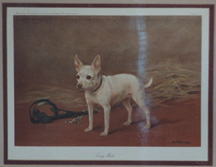 This
is Tiny Mite, a "Toy" Bull Terrier owned by Lady Evelyn Ewart
about 1907. Toy Bull Terriers were first listed at the Great
International Dog Show on May 25, 1863, which specified "under 10 pounds in weight." A Toy Variety had brief favor in the USA until
the AKC ruled in 1916 that Winner's Classes would no longer be
provided until numbers increased. Other breeds affected
by this ruling were the Bedlington Terrier and Boxer. Toy Bull Terriers
were last exhibited at Westminster in 1922.
This
is Tiny Mite, a "Toy" Bull Terrier owned by Lady Evelyn Ewart
about 1907. Toy Bull Terriers were first listed at the Great
International Dog Show on May 25, 1863, which specified "under 10 pounds in weight." A Toy Variety had brief favor in the USA until
the AKC ruled in 1916 that Winner's Classes would no longer be
provided until numbers increased. Other breeds affected
by this ruling were the Bedlington Terrier and Boxer. Toy Bull Terriers
were last exhibited at Westminster in 1922.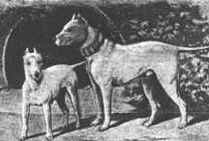 The
Miniature Bull Terrier is a fun loving, kindly gentleman that will not back down from a
serious challenge. While he doesn’t spark easily, he is a
terrier and as such, must be forgiven if he acts a bit rowdy on
occasion. He is extremely focused, brave as a bull, and for his size, exceedingly
powerful, therefore he must never be sparred. The Mini-Bull has
great speed, determination, and a singleness of purpose that could be
difficult to handle if he is encouraged to spar.
The
Miniature Bull Terrier is a fun loving, kindly gentleman that will not back down from a
serious challenge. While he doesn’t spark easily, he is a
terrier and as such, must be forgiven if he acts a bit rowdy on
occasion. He is extremely focused, brave as a bull, and for his size, exceedingly
powerful, therefore he must never be sparred. The Mini-Bull has
great speed, determination, and a singleness of purpose that could be
difficult to handle if he is encouraged to spar.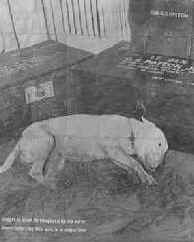 No
look at history would be complete without sharing with you the most
famous of all Bull Terrier photos. He wasn't a Mini-Bull although he
was quite small. He was gun shy but Willie loved our nation's
war commander General George Patton so much that he rode at his master's side
through the worst battles. The Feb. 1946 issue of Life Magazine
caption reads “Snuggled up against the belongings of his late
master, General Patton's dog Willie waits to be shipped home”.
No
look at history would be complete without sharing with you the most
famous of all Bull Terrier photos. He wasn't a Mini-Bull although he
was quite small. He was gun shy but Willie loved our nation's
war commander General George Patton so much that he rode at his master's side
through the worst battles. The Feb. 1946 issue of Life Magazine
caption reads “Snuggled up against the belongings of his late
master, General Patton's dog Willie waits to be shipped home”.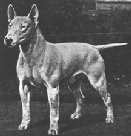 Although
the Mini-Bull of today has a much more definitive head, the solid,
well balanced, bull and terrier type is exemplified by the
famous Ch. Heir Apparent Of Monty-Ayr, owned by Dr. and Mrs. E.S.
Montgomery. (Oil painting by Edwin Megargee) It would do
well for today's breeders and judges to study this dog as to many of
the old school, he is portrayed as extreme only in muscular development.
Although
the Mini-Bull of today has a much more definitive head, the solid,
well balanced, bull and terrier type is exemplified by the
famous Ch. Heir Apparent Of Monty-Ayr, owned by Dr. and Mrs. E.S.
Montgomery. (Oil painting by Edwin Megargee) It would do
well for today's breeders and judges to study this dog as to many of
the old school, he is portrayed as extreme only in muscular development.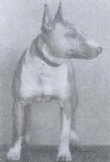 The
last exhibit of Mini-Bull Terriers at Westminster had been in 1928 but the breed was
popular and developing type in Great Britain as demonstrated in these
old photos of Eng. Ch. Navigation Red Ace (left), born 2/3/47 and later, Eng. Ch. Solway Navigation Surprise
(right), born 9/29/50, of solid Navigation pedigree and expressing advancement in breed type.
The
last exhibit of Mini-Bull Terriers at Westminster had been in 1928 but the breed was
popular and developing type in Great Britain as demonstrated in these
old photos of Eng. Ch. Navigation Red Ace (left), born 2/3/47 and later, Eng. Ch. Solway Navigation Surprise
(right), born 9/29/50, of solid Navigation pedigree and expressing advancement in breed type.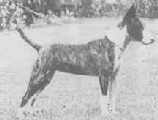 In
the States, the Variety did not come back to favor until May 1961 when
Mrs. Ralph Gordon imported Ch. Navigation Pinto and Freesail Simone.
Unfortunately, photos and records were lost in a hurricane that swept the Gulf states.
In
the States, the Variety did not come back to favor until May 1961 when
Mrs. Ralph Gordon imported Ch. Navigation Pinto and Freesail Simone.
Unfortunately, photos and records were lost in a hurricane that swept the Gulf states.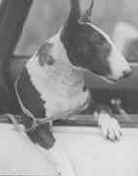 But then few had ever seen a Miniature “bull terrier” such as Eng.
Ch. Kirbeon Bandmaster, shown here . Notice his perfect head proportion, set back ears, and the
smooth downwards curve of his strong but elegant head. Whelped February 1970, he reigned supreme in England for three
years, siring 117 pups from 40 litters. Many of today’s imports trace directly to Bandmaster.
But then few had ever seen a Miniature “bull terrier” such as Eng.
Ch. Kirbeon Bandmaster, shown here . Notice his perfect head proportion, set back ears, and the
smooth downwards curve of his strong but elegant head. Whelped February 1970, he reigned supreme in England for three
years, siring 117 pups from 40 litters. Many of today’s imports trace directly to Bandmaster.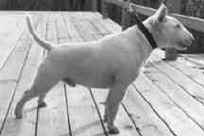 The
support of many prominent people was easily enlisted. All-Breeds Judge E. W. "Tip" Tipton once pulled a rather reluctant Max Riddle over to see “his” dog.
Within five minutes, Erenden Ephrain (left) had added Max Riddle (AKC All Breeds Judge and prolific dog book author) to his list of admirers.
The
support of many prominent people was easily enlisted. All-Breeds Judge E. W. "Tip" Tipton once pulled a rather reluctant Max Riddle over to see “his” dog.
Within five minutes, Erenden Ephrain (left) had added Max Riddle (AKC All Breeds Judge and prolific dog book author) to his list of admirers.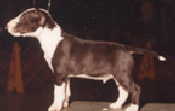 AKC
Reps kindly looked the other way when the Andrews brought little
"Surelock" to ringside although at one point, a certain Rep asked BJ to
“take the pup and the crowd away from ringside.”
Surelock Holmes O'BJ is pictured here at about 3 months, already showing perfect
balance and proportion in a very small package. The downward curve in the tail is a
proper puppy's way of not showing an incorrect "gay" tail.
AKC
Reps kindly looked the other way when the Andrews brought little
"Surelock" to ringside although at one point, a certain Rep asked BJ to
“take the pup and the crowd away from ringside.”
Surelock Holmes O'BJ is pictured here at about 3 months, already showing perfect
balance and proportion in a very small package. The downward curve in the tail is a
proper puppy's way of not showing an incorrect "gay" tail. In actuality, part of the
Standard Bull Terrier fancier's resistance to accepting the Miniature
Bull as a Variety was a reluctance to compete against competition such as the Andrews’ exceptional white
import, Eiphram (pictured left), and later, Rick Beauchamp's spectacular brindle import.
In actuality, part of the
Standard Bull Terrier fancier's resistance to accepting the Miniature
Bull as a Variety was a reluctance to compete against competition such as the Andrews’ exceptional white
import, Eiphram (pictured left), and later, Rick Beauchamp's spectacular brindle import.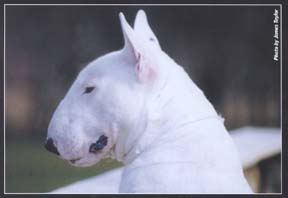 The
Standard Bull Terrier and Miniature Breed Standards may be identical but there
are differences. In the small dog, it is much more difficult to
produce the massive "down-faced" head demanded by breeder judges while achieving
the scissor mouth one must present in order to compete successfully at all-breed
shows. Pictured (right) is the Andrews' AKC Ch. "Bodacious". He finished his championship
easily enough because he was so sound and "typy" with an incredible head. He was however, undershot.
The
Standard Bull Terrier and Miniature Breed Standards may be identical but there
are differences. In the small dog, it is much more difficult to
produce the massive "down-faced" head demanded by breeder judges while achieving
the scissor mouth one must present in order to compete successfully at all-breed
shows. Pictured (right) is the Andrews' AKC Ch. "Bodacious". He finished his championship
easily enough because he was so sound and "typy" with an incredible head. He was however, undershot.


