|
 |
 |
 |
|
|
|
|
 
|


German Shepherd Dog Information
Detailed study of the GSD structure and gait by British author who provides excellent photos to illustrate correct movement as in the side gait, flying trot, slow trot...
German Shepherd Dog MovementGraham Mabbutt, Cynologist and author of "A Passion For Dogs, A Journey Of Discovery"
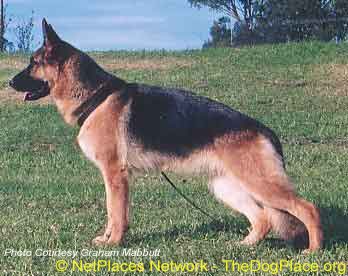
THE FLYING TROT. Since the early 1930’s, has been bred to become the German Shepherd’s raison d’être. The flying trot has a period of suspension between each diagonal and to function correctly requires the backline becoming closer to the ground as though crouched, the withers maintaining a level course, the front legs adopting a long stride, the back legs including the hocks thrusting backwards. For this long stride the German Shepherd Dog must have excess body length over height to avoid the front and back legs hitting.
Whilst all this produces speed and a flashy kind of movement particularly when straining into a chain/check collar, I know of no work (tasks to assist man) either herding, driving, running the furrow, companion, assistance, search and rescue, guiding for the blind, police, or in competitive trials or in tracking/obedience competition where the flying trot is required.
Further I would point out that in the G.S.D. in-breeding for the changed conformation and shape required for this gait as well as exaggerated angulation, bend of stifle and turn of hock, has produced a skeletal weakness and instability. The result is dysplasia of the hips, elbows and hocks including defects of the spine heightened by a lumbar spine downward bend, stretched cruciate ligaments and cow hocks more than in any other breed.
THE SLOW TROT. Judges should always remember that this two time gait is a sequel of one diagonal after the other, the left front and right rear legs moving in unison with each other, as do the right front and left rear, thus insuring the body always has perpetual support. The slow trot is ideally suited for travelling long distances over rough irregular ground. No one leg has more work to do than its opposite and the diagonal support makes it easier to maintain balance.
“The slow trot reveals the structure and conformation of the dog more than any other…”
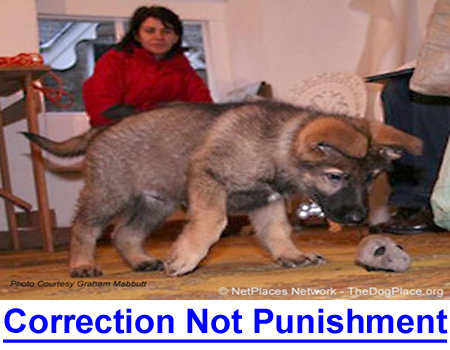
THE PACE OR AMBLE. Pacing is a two-time lateral gait where the left front and left back legs move in unison as do the two right legs. Puppies often pace as they have not as yet learned to trot.
“The pace or amble is an untidy gate of fatigue and/or physical weakness which dogs can adopt to conserve stamina.”
THE DOUBLE SUSPENSION GALLOP: NORMAL AND LEAPING STYLE. This gait is four time with four distinct supports for body weight. The supports are right rear, left rear, ,left front and then right front with a variation in its order in that the first front support comes on the same side as the last rear support and not the opposite.
The leaping style gallop has certain physical requirements not demanded by the normal gallop in that the dog must be able to get his back feet well under him without the disadvantages of a steep croup for early speed as found in the whippet which has an arched but not roached back line.
The leaping style gallop possesses two distinct periods of suspension during each sequence which gives a pronounced increase in speed over the normal style gallop. Distance runners have a flatter back line as coursing greyhounds prove.
“I know of no work (Tasks to assist man) either herding, driving, running the furrow, companion/assistance, guiding for the blind, search and rescue, police or in competitive trials or in tracking/obedience where the flying trot is required.”
“The German Shepherd since the early 1930 ‘s has been in-bred for the changed conformation required for this gait which includes exaggerated angulation, bend of stifle and turn of hock to produce a skeletal weakness and instability resulting in dysplasia of the hips, elbows and hocks including defects of the spine, heightened by a lumbar spine downward bend, stretched cruciate ligaments and cow hocks more than in any other breed.”
In summary, there is this: “Curved backs are not so good for trotting and bad for galloping, but show dogs don’t gallop – right?”
Reference & Related Information Articles by Graham Mabbutt: {1} Judges Be Judged ~ A Bit About Judging Dogs
Sadly, Graham Mabbutt passed away January 2022, he will be missed. TheDogPlace.org EST 1998 © Sept 2019 https://www.thedogplace.org/Breeds/German-Shepherd/GSD-movement-g19M09.asp SSI
SSI Advertising ~ Disclaimer ~ Mission ~ Privacy
ii NetPlacesNetwork ~ ii Health Disclaimer
Brought to you by the NetPlaces Network
TheDogPlace.org, world’s 1st public website, 1st online dog news, TheDogPress.com, and TheJudgesPlace.com, 1st AKC dog judges site
|

 Here are quotes
paraphrased from my articles ‘Judge and be Judged’ {Ref #1} also published in Vol
33.No 11. & Vol 34. No 1. Of The G.S.D. Breed Council Magazine of Great
Britain.
Here are quotes
paraphrased from my articles ‘Judge and be Judged’ {Ref #1} also published in Vol
33.No 11. & Vol 34. No 1. Of The G.S.D. Breed Council Magazine of Great
Britain.