Inheritance of an Undescended Testicle
by Sally Monroe, MD
The condition of an undescended testicle or testicles is called Cryptorchidism. This is a disorder in many breeds of dogs. Often dogs are called monorchid if they have this condition. Monorchid means only one testicle. Monorchid is technically incorrect because the undescended testicle is present, but it is not in the scrotum. A dog without one or both testicles is a very rare condition. The testicles are usually in the scrotum at about seven weeks of age. Some dogs with the condition may have them descend by 6 months, but they are considered cryptorchid. The undescended testicle should be removed due to the potential of malignant degeneration at a later date. Cryptorchidism is inherited.
Click to Enlarge image, then click
 back button to return to article
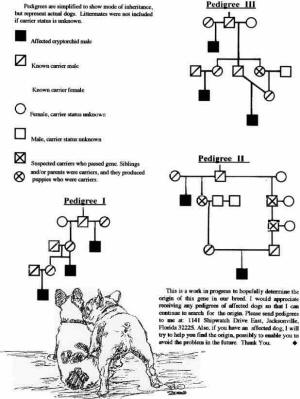 About 5-7 years ago, I became interested in this problem in French Bulldogs. Most vets at the time thought that this was a condition caused by many genes, or polygenetic. Based on my information then, I did not think so. For the past 3-4 years, I have asked owners of a male, who was affected with an undescended testis, to supply me with the pedigree of the affected male. Based on the information gathered from owners and breeders, I have found evidence that a single recessive gene is responsible. This has also been found in other breeds. Inherited disorders caused by a recessive gene require two copies of the abnormal gene to produce the disorder. This gene is carried by both females and males and is not a sex-linked gene on the X or the Y chromosome.
For a male dog to be cryptorchid, he must inherit this abnormal gene from both his sire and his dam. If a female dog gets two copies of this abnormal gene from her sire and her dam, she will not express it because she has no testicles, but each of her puppies will be at least a carrier. If she is bred to a male carrier, who has both testicles in his scrotum, but who has one abnormal gene, she may have affected males. If a female with two copies of the abnormal gene is bred to an affected cryptorchid male, all male puppies will be affected. If a cryptorchid male, likewise, is used at stud, all his puppies will be at least carriers, and if he is bred to a carrier, male puppies will be carriers or affected, and females will be carriers.
Here are the percentages:
If male and female both have all normal genes, all puppies will be normal and non- carriers or affected.
If the female is a carrier of a single abnormal gene, and the males is normal in both of his genes, each puppy has a 50% chance of being a carrier, a 50% chance of being normal.
If the female is a carrier of a single abnormal gene, and the male is a carrier of a single abnormal gene, each puppy will have a 25% chance of being totally normal, each puppy will have a 50% chance of being a carrier of a single abnormal gene, and each puppy will have a 25% chance of having two abnormal genes. In this case females carry two abnormal genes, and the males are cryptorchid.
Because females are carriers, with either one or two abnormal genes, without expression of them, you can go generations without seeing a cryptorchid male. It takes a female carrier mating with a male carrier, producing an affected son. to show that she carries the trait. Males and females may carry the trait and never produce an affected dog just because of the odds. It does not mean they are not carriers. That they were carriers can be revealed in later generations.
How can this help you in breeding? If you have a litter with an affected male, the sire and the dam are carriers. Inquire of the owner of the sire about other puppies that he may have produced with the problem. This is not difficult because it is obvious, but the breeder may not tell you. The next question is whether the dam has produced other affected sons. She may not have because litters are small. Ask about litter sisters of the dam. Have they produced affected males? By tracing common ancestors on each side of the pedigree, you may be able to find the common link, the dog or bitch with the trait that you want to avoid. Inbreeding and line breeding tends to accentuate the problem. More carriers can be recognized due to increased potential of encountering the affected male.
Pedigrees are shown of dogs given to me that show this mode of inheritance.
Any questions can be referred to me. The opinions expressed in this article are mine and mine alone and do not reflect any association with any organization or committee.
https://www.thedogplace.org/Breeds/French-Bulldog/Undescended-Testicle_Monroe.asp
SSI
Advertising ~ Disclaimer ~ Mission ~ Privacy
ii NetPlacesNetwork ~ ii Health Disclaimer
Brought to you by the NetPlaces Network
TheDogPlace.org, world’s 1st public website,
1st online dog news, TheDogPress.com, and
TheJudgesPlace.com, 1st AKC dog judges site


