


Coton de Tuléar Information
If you own or are about to buy a Coton, get the total picture, candid Coton de Tulear photos, and no-hype information from top Coton breed authorities.
THE COTON de TULEAR HISTORY
Courtesy of United States of America Coton de Tulear Club - Established 1993
Submitted by Ruth Weidrick, Past-President
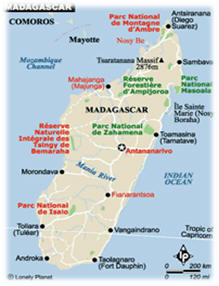 The Coton de Tulear (Cotton of Tulear in French) originates from
Madagascar, the world’s fourth largest island off the southeast
coast of Africa in the Indian Ocean. The capital of Madagascar
is Antananarivo. Tulear is a small sea port city at the southern
tip of the island. The city was renamed Toliara after the
formation of the new, independent government, The Republic of
Madagascar (Repoblikan'i Madagasiraka).
The Coton de Tulear (Cotton of Tulear in French) originates from
Madagascar, the world’s fourth largest island off the southeast
coast of Africa in the Indian Ocean. The capital of Madagascar
is Antananarivo. Tulear is a small sea port city at the southern
tip of the island. The city was renamed Toliara after the
formation of the new, independent government, The Republic of
Madagascar (Repoblikan'i Madagasiraka).
Although French is still
spoken widely in Madagascar, Malagasy is spoken by most of the
18 million people who inhabit the island. The island's people
are extremely poor, and people there are often just barely
surviving. There are many good humanitarian agencies working in
Madagascar and with international interest in the many unique
creatures that live there, hopefully the people and the forests
will benefit. Madagascar's forests are a shimmering mass of
dripping leaves and quirky creatures: lemurs, baobabs, geckoes, sifakas and octopus trees. Sadly, they are threatened by
aggressive deforestation. The Indian Ocean tsunami of 2004 hit
Madagascar's east coast near the towns of Manakara, Sambava and
Vohemar, destroying infrastructure and leaving close to 1000
people homeless. Luckily no deaths were recorded. This is also
an area where the Coton de Tulear still lives.
It's in the forests of Madagascar and with these people that our
little Cotons lived near the sea, in the same area as the now
famous ring tailed lemurs. A woman of Indian descent from France
who grew up in Tulear was recently visiting Portland, Oregon
where she instantly recognized one of the club member's Cotons.
She told stories in French of how these little dogs were the
precious pets of many richer households, were traded across the
channel to Africa into Mozambique, and were the friendly dog
street urchins running in packs in the city and outlying forest
when she was growing up.
Historically, the Coton’s arrival to Madagascar dates to
approximately to the 15th century. Ships frequently sailed to
the West Indies around Africa’s Cape of Good Hope into the
Mozambique Channel to the Indian Ocean.
Sea voyages were often long and boring and sailors’ quality of
life was very poor. To offset these hardships and the loneliness
of the ladies also traveling on these ships, little spirited
white dogs accompanied them. The same little dogs were also used
to rid the ships of unwanted mice and rats. They could be
trained and were more companionable than cats, and many ocean
going people found small white dogs excellent seafaring
companions.
There is a common story that during a violent
storm, a shipwreck occurred in the proximity of Tulear,
Madagascar. No one knows the name of the ship or its flag but
all versions of the story tell that all the sailors perished.
Some of the little white dogs from this ship swam ashore near
Tulear, and it is assumed that they are the ancestors of the
Coton de Tulear. These little white dogs also developed into the
Bichon Frise, the Bolognese, Maltese and other similar breeds.
You can see these small dogs in some Renaissance paintings,
sitting with royal ladies and notable figures.
The dogs settled on the island, became wild, and eventually met
with the local dogs. The Coton de Tulear resulted from this
relationship. It's thought by some that the deep coloration on
puppies that later fades to white or champagne came from this
cross breeding. There is a small wild dog, now extinct, with a
patchy brown, black and tan coloration of the wild dogs of South
Africa that lived in this area during the time of the Coton, and
a mix of this wild dog with the small white dogs from the ships
may have resulted in the coloration we see on Coton puppies.
It's also thought that the common dog of Madagascar, a mix of
many breeds where also their ancestor. There were also terriers
on the island. Whatever the ancestry the Coton de Tulear is as
unique as many animals found on the wild and isolated island of
Madagascar, and people who live with them can attest to their
not being quite like other dogs in their intelligence, happy
temperament, and unique vocalizations, just a few of the many
excellent traits of the rare Coton de Tulear.
These little dogs foraged for food to survive and learned to
protect themselves against bigger predators. There are stories
that they even hunted in packs. Even now when numbers of Cotons
live together, they form strong heretical packs. The Coton de
Tulear still has many primitive attributes, and will hunt for
fun if given the chance. Coton packs always have a strong female
leader who keeps everyone in line. The males are less dominant,
although the Alpha male is clearly the top male in the pack.
Unlike many breeds that have been around for a long while, it's
easy to tell the male Cotons from the females. The females are
truly little ladies, and the males are somewhat larger and more
masculine. If you go the home page of this site and refresh your
browser, you will cycle through a number of photos of Cotons.
It's easy to spot the females and to see the difference in the
males. Because the Coton de Tulear has not been bred for very
long, it's easy to see the difference between individuals,
unlike breeds who have been bred for a long time where each
individual looks a lot like the others, and males and females
are similar.
Here is the story from Madagascar about
Cotons who wanted to cross a river infested with crocodiles:
There were a number of large reptiles with wide open mouths
waiting patiently for a feast near a river. Since swimming
across was sheer suicide, our dogs needed a diversion to reach
the opposite bank, and that is exactly what they did. The dogs
looked first for the narrowest passage and left some of the pack
there. Then some ran to the widest part of the river and started
barking ferociously on the bank. The racket lured all the
crocodiles to that spot where they got out of the water and
slowly made their way to where they heard the barking dogs. Our
sly dogs sprinted back to the narrowest passage, jumped in the
water and swam across! The native Malagasy's fell in love with
these little dogs, domesticated them and then offered them as
gifts to the King and the Merino nobles. Because of their
charming personalities and adorable appearance, the Coton soon
became a favorite of Kings and nobles. For many years, only
people of the ruling caste were allowed to own a Coton. Around
the turn of the century, French colonials also fell under the
spell of the Coton. The breed has only been recognized since
1971 when a Frenchman brought some dogs from Madagascar with him
back to France and established it as a breed.
According to the Federation Cynologique
Internationale (the FCI) breed standard, the height of the male
at the withers varies between 25 cm to 32 cm (approximately 9.8
in. to 12.5 in.) with the ideal being 28 cm (11 in.) and the
height for the female at the withers varies between 22 cm to 28
cm (approximately 8.5 in. to 11 in.) with the ideal being 25 cm
(11 in.) The male weighs between 4 to 6 kg (approximately 8.8 to
13.2 pounds) and the female weighs between 3.5 to 5 kg
(approximately 7.7 to 11 pounds).
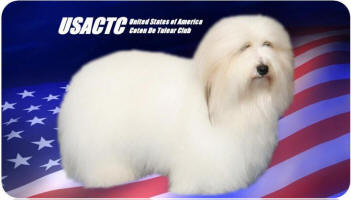
The Coton de Tulear is a small, sweet “cottony” long-haired dog
with a big dog’s heart. The coloring is white, champagne and
white and also tricolor. It is a happy, somewhat boisterous
little companion, often acting like a clown, very eager and
intelligent, and forms very strong bonds with his/her masters.
The dark brown eyes are round, well spaced, rimmed with black,
showing a lively and intelligent expression. The nose is black
the lips are thin and rimmed with black. The ears are dropped,
thin, triangular and covered with long hair. The ratio of the
height at the withers to the length is 2:3. The Coton de Tulear
has a slightly curved top-line which in part differentiates him
from other members of the Bichon family.
The Coton thrives on love, food, human
companionship and protection from his family. It will never tire
of too much TLC! Pet him, carry him, talk to him and you will
see great results. He will shower you with kisses since he is so
affectionate and, being a good listener, will cock his head to
the side while you talk to him. Being a lively companion, he is
always ready to play, seldom tires and will clown around and
jump to attract your attention. He will happily trot next to you
in the house, observe your gestures and vocalize to you with a
particular sound that does not resemble barking, but more like
grunting or growling, so go ahead, make his day, and answer him
in the same fashion.
 The Coton gets along well with other dogs, cats and children. He
is a good traveler, is easily trained and housebroken. He will
love taking walks with you (on a leash of course). The Coton is
seldom sick and has an approximate life span of 15 to 19 years.
Although he is very hardy, and does not mind to playing in the
rain and the snow, he still is an indoor dog. While not known as
a "guard dog" the Coton is an excellent alarm dog. He is very
protective of his house and master and because of his keen
hearing he will alert you right away to strange noises.
The Coton gets along well with other dogs, cats and children. He
is a good traveler, is easily trained and housebroken. He will
love taking walks with you (on a leash of course). The Coton is
seldom sick and has an approximate life span of 15 to 19 years.
Although he is very hardy, and does not mind to playing in the
rain and the snow, he still is an indoor dog. While not known as
a "guard dog" the Coton is an excellent alarm dog. He is very
protective of his house and master and because of his keen
hearing he will alert you right away to strange noises.
Puppies are born either all white or with spots, mainly around
the head and the ears, but also sometimes on the body. These
spots which are yellow, brown, rust or black, disappear as the
Coton matures and can leave behind a light to medium champagne
and/or grey coloring.
The hair is shorter as a puppy but reaches approximately four
inches or so in adulthood. Because the Coton has minimal
shedding (mainly springtime) and has hair and not fur, he is a
good choice for people with allergies.
The Coton de Tulear's hair is soft and fluffy to the touch,
non-oily, and light as the cotton flower. Gentle brushing 3 or 4
times a week with a special pin brush (without balls at the end
of the pins which tear and damage the coat) will help alleviate
matting that can occur especially behind the ears, legs and
elbow region. Particular attention will be needed with the coat
between the age of 9 to 14 months when the adult hair is coming
in. Matting can be at its highest during that time. Besides the
fact that the dog will love the attention if introduced to
grooming as a puppy, less bathing will be required. If you need
to bathe the dog, make sure to use an appropriate shampoo for
the Coton coat and its hair. How often to bathe depends upon
many factors and your own individual choice. Please remember
that, when it comes to advice, your breeder and veterinarian can
offer you invaluable help. You can also get a lot of help from
other members of the
USACTC,
which is a great source for all Coton owners.
TheDogPlace.org EST 1998 © 1106 https://www.thedogplace.org/Breeds/Coton/History_USACTC.asp


